
Transparency is one of COPA’s core values and is essential to rebuilding trust with both civilian and sworn residents of the City of Chicago. The dashboard below provides information about COPA’s investigatory work. Definitions and additional resources can be found beneath the dashboard. To view the City of Chicago’s complaint-level data platform, click here.
🗳️ How Complaints are Processed
When a complaint of police misconduct is filed, it is first reviewed and assigned to either the Civilian Office of Police Accountability (COPA) or the Bureau of Internal Affairs (BIA), depending on the nature of the allegation. COPA investigates serious allegations such as excessive force, bias-based verbal abuse, firearm discharges, deaths or serious injuries in custody, sexual misconduct, and improper searches or seizures. BIA investigates all other complaints of misconduct, including criminal activity, operational violations, theft or property misuse, substance abuse, residency violations, and medical roll abuse.
📘 Understanding Overview Tab
This tab provides a snapshot of the complaint system, showing the total number of complaints and how they are distributed between COPA and BIA. It highlights who filed the complaints, breaking them down by civilians and CPD members, and shows both the number of open and closed cases to date. The tab also presents the most common allegation categories, highlighting the kinds of concerns most often reported.
📘 Understanding Allegation Data
This tab provides a snapshot of allegations that were accepted and closed during the selected year, showing how they are distributed by district and category. It highlights both the number of allegations accepted in the selected year and the number of allegations closed during that year, regardless of when the complaint was originally received. The tab also displays the percentage of allegations recommended as Sustained among those accepted and among those closed. The map uses a color scale to represent the number of allegations accepted in the selected year by district, with lighter shades indicating fewer allegations and darker shades indicating higher numbers; districts shown in gray had no allegations accepted during the selected year. All findings shown on this page reflect COPA’s recommended findings at the time an investigation is closed and do not represent the final outcome of a case.
- Allegations represent individual claims of misconduct and potential CPD rule or policy violations, and are evaluated individually.
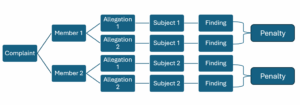
- This is highlighted in the diagram below which is an example of a complaint that involved two members where each of the members received two allegations of misconduct against two different subjects. Each allegation has its own finding, but the penalty relates to COPA’s penalty recommendation for each member after considering the totality of the circumstances.
- The % Sustained metric reflects the proportion of allegations with a “Sustained” finding out of all allegations with a formal finding (e.g., Sustained, Not Sustained, Exonerated, Unfounded, or Within Policy).
- A district is a geographical area patrolled by Department members who operate out of a centralized police facility. Chicago has 22 police districts. “Other” refers to misconduct complaints involving members of the Chicago Police Department that took place outside city limits.
👥 Role Definitions
- Accused: The member alleged to have committed misconduct
- Subject: The person directly involved in the incident
- Complainant: The person who filed the complaint (may also be the subject)
🔁 Case Dynamics
- A single case can include multiple allegations, one or more accused member, and multiple complainants.
- Subjects who are also complainants will appear in both roles.
- Age reflects how old the person was at the time of the incident, not their current age.
⚠️ Missing or Ambiguous Data
- Demographic values such as “Unknown” or “Other” appear when information was not reported, not collected, or could not be determined during the investigation.
ℹ️ Understanding Officer-Involved Shootings
- Officer Involved Shooting (OIS) cases are typically notification-driven, not submitted through public complaints. COPA is notified when a member discharges a firearm during an incident.
- Each OIS case may involve multiple members. The chart shows penalties given to members when at least one allegation against them was sustained.
- Charts display only formal outcomes. For findings, this includes Sustained, Not Sustained, Exonerated, Unfounded, and For penalties, this includes Reprimand, Suspension, Separation, and Violation Noted. Cases without a formal finding or penalty are excluded, including those closed early due to insufficient evidence, jurisdiction, resignation, or death.
📘 Understanding Case Outcomes
- All metrics reflect case-level data, except for allegation categories by allegation finding, which shows individual allegations.
- A single case may contain multiple allegations, but if any are sustained, the entire case is counted as sustained . Only sustained cases result in discipline recommendations.
- Cases closed without a finding were investigated but did not proceed to a formal outcome, typically because they fell outside COPA’s jurisdiction or lacked sufficient evidence to investigate.
- The disciplinary action chart does not include the “Other” category, which covers cases where no penalty was imposed, such as involved member(s) resignation, death, or the recommended discipline was training or other remedial recommendation.
- Disciplinary recommendations apply only to members with sustained allegations. The dashboard includes only accepted complaints that led to a formal COPA investigation. However, a case may still be accepted and closed early if COPA determines the allegation lacks sufficient evidence or falls outside its jurisdiction after further review. Dashboard metrics reflect both case-level and allegation-level data depending on the chart. Refer to chart titles and footnotes for clarification.
COPA Intake and Investigative Jurisdiction
When a complaint is received by COPA, COPA intake staff review the complaint to determine whether it falls under COPA’s jurisdiction to investigate. Complaints involving serious misconduct, such as excessive force, coercion, or civil rights violations, are under COPA’s jurisdiction and investigated by COPA. Complaints outside of that jurisdiction are referred to the Chicago Police Department’s (CPD) Bureau of Internal Affairs (BIA) for investigation.
Complaint/Case
A complaint that is within COPA’s jurisdiction is treated as a case to be investigated and is tracked using a “log number”. One complaint (i.e. case) may represent multiple allegations of wrongdoing against multiple members and may also involve multiple complainants or multiple targets (i.e. subjects) of the misconduct.
Complainant
A person who reports misconduct is typically referred to as the complainant. The complainant is not always the person affected by the misconduct and can include third parties or witnesses. There can be multiple complainants related to a case under investigation
Subject
A person who is the subject of alleged misconduct. The subject can also be the complainant if the complaint is self-reported. A case can have multiple subjects if the alleged misconduct applies to multiple individuals.
CPD Member
A sworn law enforcement officer or civilian employee of the Chicago Police Department
District
A geographical area patrolled by Department members who operate out of a centralized police facility within the district. Chicago has 22 districts. To find your district, click here.
Allegation
Allegations describe specific misconduct, indicate a potential violation of CPD rules or policy, and are evaluated individually. COPA issues a recommended finding for each allegation that falls under one complaint.
Finding
A finding is determined when after a fair, thorough, and independent investigation, sufficient proof is obtained to warrant a determination of Sustained, Not Sustained, Unfounded or Exonerated. COPA makes investigative findings of Sustained and Not Sustained based on the “Preponderance of Evidence” standard in which the evidence must show it is “more likely than not” that the incident did or did not occur as alleged. Findings of Unfounded and Exonerated must be supported by “Clear and Convincing” evidence. Clear and Convincing evidence is a higher standard than Preponderance of Evidence, but less than “Beyond a Reasonable Doubt.”
If COPA sustains a finding, it will make a disciplinary recommendation to the Superintendent of Police, who may agree (concur) or disagree (not concur). If the Superintendent does not concur, the case proceeds through additional steps, which may delay closure. If any allegation is sustained, the entire case is considered sustained.
A finding represents the conclusion of an investigation and may be reported at either the allegation level or the case level. Formal findings include the categories Sustained, Not Sustained, Exonerated, and Unfounded.
At the allegation level, each allegation is assigned its own formal finding and findings are not ranked.
At the case level, a single formal finding is assigned to summarize the overall outcome of a case when multiple allegations are present. Case-level findings are determined using a ranking order, with the highest-ranked allegation outcome defining the case-level finding. The ranking order is: Sustained, Not Sustained, Exonerated, and Unfounded.
All formal findings reflect COPA’s recommended conclusions at the time an investigation is closed and do not represent the final outcome of a case.
Sustained
The allegation was supported by sufficient evidence (“Preponderance”) to justify disciplinary action. Recommendations of disciplinary action may range from Violation Noted, to Suspension, to Separation from the Department.
Not Sustained
The allegation is not supported by sufficient evidence (“Preponderance”) to prove or disprove the allegation.
Unfounded
The allegation was not supported based on facts revealed through investigation, or the reported incident did not occur, as shown by “Clear and Convincing Evidence.”
Exonerated
The incident occurred, but the action taken by the member was lawful and proper, as shown by “Clear and Convincing Evidence.”
Within Policy Officer-Involved Shooting
A finding applicable to officer-involved shooting or an officer-involved death investigations where it is determined by a preponderance of the evidence that a CPD member’s use of deadly force complied with CPD policy.